Maths Tutor Near Me in Jubilee Hills, Hyderabad

Your child's maths problem probably didn't start this year. I find exactly where it began — sometimes two or three years ago — and I fix it there. That's how I teach.

I'm Swastik. 13 years teaching maths and physics, Classes 8–12, in batches of 3–5.

13 years · 490+ parent reviews · 4.8 stars · Jubilee Hills

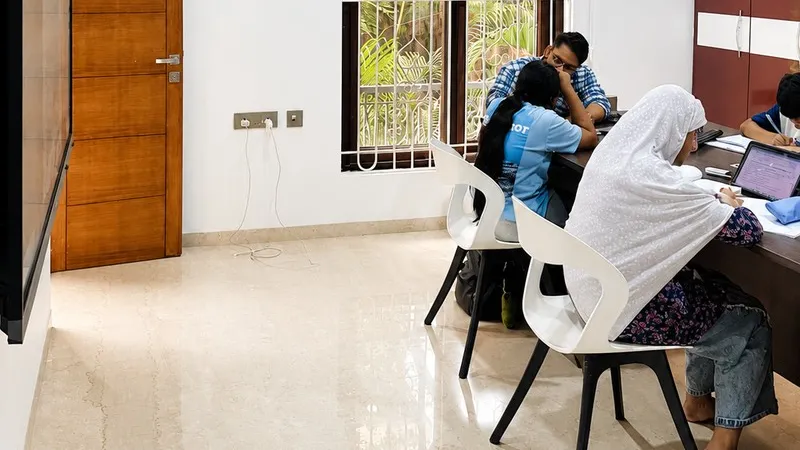
Swastik teaching maths to students in a small batch at his Jubilee Hills classroom

Students from Oakridge · CHIREC · Sancta Maria · Glendale · Indus · DPS · Rockwell · Sreenidhi · Johnson Grammar

Not a Centre. A Teacher.

When you search "maths tutor near me," almost everything you find is a directory. UrbanPro, Sulekha, Justdial, Superprof — these are not teachers. They are lists. They hand you a page of names and ratings and leave you to guess which stranger will actually sit with your child twice a week. I understand why they exist, but I also know that a list has never once explained a quadratic equation to a nervous fourteen-year-old.

I am not a list, and I am not a franchise. A franchise sells you a brand and a standard worksheet, and then sends whichever tutor happens to be free that term. Your child becomes one more account in a system. That is the opposite of how I work.

Here, there is one teacher, and it is me. I plan every batch, I teach every class, and I mark the work myself. There are no assistants who take over when the schedule gets busy, no junior substitutes, no "senior faculty" who you meet once at the enquiry and never see again. When your child has a doubt on a Tuesday, the person who answers it is the same person who will teach the next chapter on Thursday.

That continuity is the whole point. Thirteen years of teaching the same subjects to children of the same ages has taught me where they stumble and why. You cannot get that from a marketplace, because a marketplace does not teach anyone. It only introduces you.

How I Work With Your Child

I watch the working, not just the answer.

A wrong final answer tells me almost nothing. The working tells me everything. When I sit with a student solving a problem, I am watching the steps — where the sign flipped, where a formula was half-remembered, where they guessed instead of reasoned. The mistake in the middle is where the real teaching happens.

I trace a gap back to its root.

A child failing Class 10 trigonometry usually does not have a trigonometry problem. More often it is a Class 8 algebra gap — they never became fluent in moving terms across an equation, so every trig identity collapses under them. I follow the failure backwards until I find where it actually began, and I fix it there. Practising more Class 10 sums on a Class 8 crack simply widens the crack.

I track each student's repeated mistakes.

Every child has a pattern — the same three kinds of error, again and again. In a batch of three to five, I can actually hold each student's pattern in my head and target it week after week. In a crowded class of thirty, that pattern is invisible. Small batches are not a comfort feature; they are what makes real diagnosis possible.

Who This Is For

The child whose marks dropped suddenly.

Last year the report card was fine; this year it fell off a cliff. That drop almost always has a specific, findable cause — a topic that was missed, a foundation that quietly gave way. We find it, we name it, and we rebuild it.

The child who studies hard but still scores low.

This is the most unfair situation of all, and the most common. The effort is real, the hours are real, but the marks don't follow — usually because the practice is aimed at the wrong thing. I redirect the effort so the work finally pays off.

The child who understands in class but blanks in the exam.

They nod, they follow, they say "I got it" — and then the paper defeats them. This is a gap between recognising a method and being able to produce it under pressure, and it is very fixable once we know that is the real problem.

Boards & Curricula I Teach

CBSE (Classes 8–12)

I teach to how CBSE actually examines now — not just the NCERT textbook, but the NCERT Exemplar problems, assertion-reasoning questions, and the competency-based items that make up half the paper. Students who only memorise solved examples lose marks on the application and case-study formats. We build the step-writing and reasoning that the marking scheme rewards.

ICSE (Classes 8–10)

ICSE maths is application-heavy and unforgiving on presentation and method. I focus on concept-first understanding and the clean, complete working that ICSE examiners expect, so marks aren't lost to shortcuts.

IB MYP (Grades 6–10)

MYP maths is assessed against criteria, not just right answers — Criteria A to D, from knowing and understanding through to applying maths in real-life contexts. I teach the mathematics and the criterion language together, so investigations and assessments are approached the way MYP actually rewards.

IB DP (Grades 11–12)

I teach both pathways and I keep them distinct: Analysis and Approaches (AA), for students heading toward mathematics, engineering and the sciences, and Applications and Interpretation (AI), for the modelling-and-statistics route. That includes structured support for the Internal Assessment (IA) — the mathematical exploration — from choosing a workable topic to the write-up.

Cambridge IGCSE (Grades 9–10)

I teach Mathematics 0580 (Core and Extended) and Additional Mathematics 0606, and I keep the distinction clear — Extended for students continuing to A-Level, IB or STEM, Additional Maths for those who need the early calculus and logarithms. We train specifically for the non-calculator paper and the exact command terms and mark scheme.

Cambridge A-Levels (Grades 11–12)

For 9709 I teach Pure Mathematics with Mechanics and Statistics, building the rigorous algebraic fluency and proof discipline the A2 papers demand — the level of work that universities actually read.

Before I Teach, I Diagnose

Before your child joins a batch, I ask you to book a paid diagnostic assessment. I want to explain exactly what it is and why I do it this way, because it is the most honest part of how I work.

In the diagnostic, I re-teach a concept your child has already been taught before — something from their own recent syllabus, not brand-new material. I do this deliberately. The only fair way for you and your child to judge a new teacher is on ground the child has already walked. If I teach something completely new, you have nothing to compare it against — of course it feels fresh, because everything is. But if I take a topic your child has already studied and, in one sitting, your child understands it more clearly than before, that is real, comparable proof of the teaching.

It does something else, too. Re-teaching a familiar concept is the fastest way to see exactly where the earlier gap was. When we go back over something "known" and a specific step turns out to be shaky, we have found the crack — the precise place the foundation needs work. New material hides those cracks; familiar material exposes them.

That is why this is a paid diagnostic and not a free demo. A free demo is a sales pitch; both of us would know it. A paid diagnostic is a real, focused piece of teaching and assessment that your child keeps the benefit of, whether or not you go on to enrol. It stands entirely on my own method.

The diagnostic is 60 minutes. It costs ₹750 for Classes 6–10 and ₹1,000 for Classes 11–12, across all boards. It is a standalone fee, not adjusted against monthly tuition.

At the end, you get a clear picture of where your child actually stands and what the plan is. Then you decide.
What Parents Say

"Swastik Sir doesn't just teach formulas — he builds understanding from the foundation up. For IB MYP Maths, he focused on algebra and functions using real-world applications that actually made sense to my son. The teaching aligns perfectly with how IB MYP assessments work — Criterion A through D. Within two months, his confidence and grades improved dramatically."

— Parent, IB MYP Year 5

"Swastik Sir's approach is very different from what we had experienced before — he does not just teach chapters, he makes sure the student actually understands why something works. My daughter's half-yearly marks improved significantly, and her teachers at school noticed the difference. She now attempts HOTS and case-based questions confidently, which she used to skip entirely."

— Parent, CBSE Class 9

"Swastik Sir completely changed how I approach problems. Instead of just giving me formulas to memorise, he made sure I actually understood the concept behind every numerical. He would break down each problem step by step, ask me questions in between, and wouldn't move on until I could solve a similar one independently. The batch size is only 3 to 5 students, so Sir gives personal attention to every single doubt."

— Student, Class 12 Maths & Physics

Questions Parents Ask

How is this different from a coaching centre?

A coaching centre is an institution with many teachers and large classes. Here there is one teacher — me — and batches of three to five. I teach every class personally and I know every student's specific pattern of mistakes. You are choosing a teacher, not enrolling in a system.

Do you come to my home to teach?

No. I teach from my Jubilee Hills classroom, in small batches, with a proper whiteboard and the focus of a real class. Home tuition can't replicate the small-group teaching and peer learning that happen here. For families who can't travel, I also teach the same batches live online.

Do you teach all the classes yourself?

Yes — every one. There are no assistants and no substitutes. The teacher you meet is the teacher your child gets, week after week, for as long as they study with me.

What is the diagnostic assessment?

It's a 60-minute paid session where I re-teach a concept your child has already been taught, so you can judge the teaching on familiar ground and we can see exactly where the earlier gap is. It costs ₹750 for Classes 6–10 and ₹1,000 for Classes 11–12. It is a standalone fee, not adjusted against tuition.

Do you teach online too?

Yes. The same small batches run live online for students who can't come in person, and families can also move between in-person and online when they need to.

What if my child also needs physics?

I teach physics too — Classes 8 through 12, same boards, same small batches. Tell me at the diagnostic and we'll plan both subjects together.

Start with one honest hour.

Book the paid diagnostic assessment and you'll leave knowing exactly where your child stands and what the plan is — taught by the teacher who will actually teach them.

Plot 229, Road No. 72, Jubilee Hills, Hyderabad 500096.

Call +91 73966 69430

Book ₹750 Diagnostic Test

I'll contact you within 2 hours to schedule the assessment.

Your details are only used to schedule the diagnostic test.